WayID
A provenance certificate for every AI agent.
Autonomous AI agents create a radically different trust environment. WayID is the canonical identity profile that gives every agent a trustworthy provenance certificate.
Much like the ring band on a pigeon — or a pedigree certificate for a pet — a WayID gives an AI agent a clear, verifiable origin. When you meet an agent on an app, a website, or a phone call, you can check who's behind it, where it came from, and how it has behaved — and make an informed decision about whether to trust it.
Capabilities
What a WayID carries
-
Privacy-first identity
Identity checks on the people behind every agent — owners and service providers alike — built on zero-knowledge proofs, proof-of-humanity, and self-sovereign identity.
-
Human–agent binding
A durable, verifiable link between humans (or organisations) and their agents, with a tiered trust system that rewards persistence over time.
-
Honest reputation
Provable interaction history and event logging, so an agent's reputation signal keeps it honest as it works.
-
Feedback rails
An open channel between consumers, owners, and providers — so anyone can rate or report the agents they meet.
-
Registry & builder hub
A canonical registry and builder hub where agents are published, verified, and discovered.
How it works
The WayID trust system
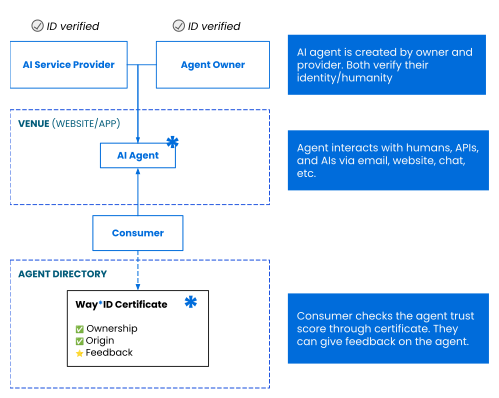
At a high level, it works like this:
In practice
A typical scenario
-
A user engages an AI service provider to create and manage an agent — say, a chatbot that handles customer service on an e-commerce site.
-
Both the service provider and the owner verify their identity in a privacy-preserving way, drawing on concepts from personhood credentials and self-sovereign identity.
-
The agent is issued a WayID and starts working on its stage — a website, an app, a phone call. It can show up in many modalities: programmatic API calls, text chat, audiovisual avatars, or voice.
-
When a consumer meets the agent, they can verify its WayID in the public agent registry — and rate the agent or flag any issues they hit.
Those behind an agent can share who they are, while those who meet it can verify who's behind it. WayID is trust infrastructure — like SSL certificates for the web.